

'Terrible Twos' And 5 Other Awful Childhood Phases From Birth To Age 7
Working through the emotions, tantrums, and meltdowns that seem to evolve with each new day in parenting can be exhausting — especially for first-time moms. What's more, many of the habits we turned to while pregnant to relax and minimize stress (like binge-watching movies and TV shows about pregnancy) are no longer possible once our babies arrive and start to demand our time and attention. In solidarity with moms of youngsters — whether you're raising your first or working through unexpected surprises with your fourth (it never gets easy, does it?) — we've compiled what to look out for in every age range, along with evidence from parents and experts that we're not alone, so we don't have to lose our minds worrying.
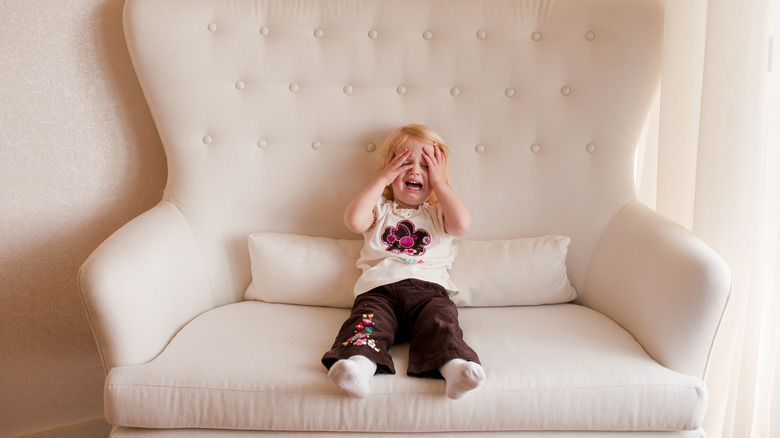
First, there's the stage that nearly all moms-to-be are forewarned about, the "terrible twos." Typically observed between 18 and 36 months, this is a time when kids start to feel pulled by a desire to do more on their own. While their longing to explore is strong, their language development has not quite caught up yet, which can lead to emotional outbursts and frustration. As clinical psychologist Dr. Becky Kennedy explains in her blog, during what she refers to as "the turbulent two's," defiance is par for the course. "If your kid's new favorite word seems to be 'no,' you're not alone. Refusing requests and testing boundaries are part of how toddlers explore their sense of autonomy and independence."
Baffling babies

Before the "terrible twos" set in, and before our babies begin to build the vocabulary they'll use to argue with us during their later stages, we might think we're in for a period of smooth sailing, but moms who've experienced the "baffling babies" stage know that's not true. We chose the word "baffling" because it's particularly challenging for parents to guess what their little one needs based on facial gestures, hand movements, and crying. So. Much. Crying.
This stage encompasses the infamous "witching hour" for babies – a recurring period in the late afternoon to early evening, day after day, during which an otherwise content baby becomes extremely fussy. During the witching hour, parents may discover that usual calming methods become ineffective. Additionally, there's colic — a similar phenomenon in which a healthy baby cries long, hard, and often. Colic typically peaks at 6 weeks old and begins to decline at 3 to 4 months old.
Certified pediatric sleep consultant Cara Dumaplin explains in her blog that occurrences like the witching hour happen when babies become overtired and their bodies release adrenaline and cortisol into their bloodstream. "This makes falling asleep nearly impossible when babies need it most, and then the never-ending cycle of crying begins," Dumaplin says. "You can help avoid over-tiredness by following your baby's sleepy cues and wake windows."
Teenagers at age 3

Rivaling the "terrible twos" in infamy among parents is the "3-nagers" — a stage with several Reddit threads devoted to discussion and commiseration. This is the age when parents often draw parallels to the rebellious behaviors associated with adolescence, like arguing and questioning rules. While the "terrible twos" usher in the word "no," the "three-nager" stage brings the question, "why?"
A group of Reddit parents at r/toddlers referred to the incessant "why" questions from their 3-year-olds as the "why cycle." One parent wrote, "Every time you tell him to do or not to do something, it's a 'why?' response. Which is good cause he is trying to understand, however, I think he's more often using it to just beat around the bush of actual obedience lol."
Combative behavior in 3-year-olds can also lead to "passive noncompliance" — delaying a parent's request after several attempts, or just flat-out ignoring it. As clinical expert Dr. Melanie A. Fernandez wrote for the Child Mind Institute, parents should address passive noncompliance as early as possible, before it escalates. "That gets problematic because school is not going to work down the road if the child doesn't comply with teachers' requests," Fernandez said. "Even things like crossing the street are dangerous if the child is passively not complying to, 'Please hold my hand.'"
Foul-mouthed 4-year-olds

From a little one's perspective, turning 4 can be a confusing time. Kids at this age start to branch out and do more "big kid" things (like eating popcorn), but they're still not quite ready to leave the nest and head off to traditional school. As parenting expert and author Nicholeen Peck explains in a YouTube video, "Four years old is this magical age when your child starts to really transform. They're switching from being a toddler into being a young child." This pre-school age comes with high energy and increased body awareness (and thus, more exploratory physical movement or "fidgeting").
Parents often note that their children start to make scandalous language choices at this age as well. One parent on Reddit opened a thread by saying, "4 y/o won't stop cursing," and noted, "I figured it was just a phase and if we ignored it he'd stop, but it's just become part of his vernacular now." Parents in the comments chimed in to say they related to the experience. Expert child development insights suggest this is a common aspect of social and language development at this age. In fact, 4-year-olds grow their conversation and storytelling skills. They can be prone to exaggerating details and even use words and phrases associated with "potty talk" (think "poopy head").
Struggling 5- and 6-year-olds
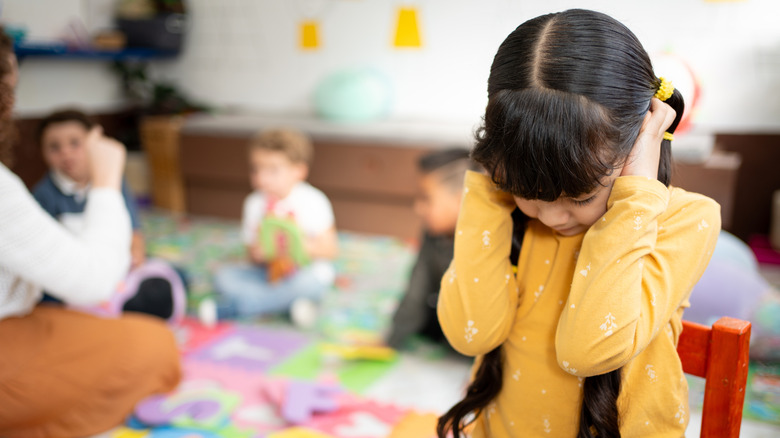
For most children in the United States, ages 5 and 6 mark a milestone stage. Parents and child development experts note that kids' reactions to the start of traditional school can vary greatly — some walk through the doors confidently without looking back. Others may struggle more, experiencing a phenomenon known as kindergarten regression, a coping mechanism in which behaviors revert that's brought on by stress. Other signs of kindergarten regression include needing help with tasks they've previously mastered (like buttoning their pants and tying their shoes), as well baby talk, thumb sucking, and other behaviors exhibited during younger years.
Some parents also note restraint collapse in kindergarten children — the meltdown that happens at home after a day of repressing emotions and behaviors. Restraint collapse is common, especially in children who are gifted or twice-exceptional. As psychologist and author Tania Johnson explained on the Child Psych podcast, "... when [kids] get home to their safe place to their safe person, we see that lid comes off in different ways for different kids."
Sensitive 7-year-olds

Once a family has made it through a child's kindergarten year, parents might hope for a break — or at least a dip in the emotional roller coaster — but alas, the "sensitive 7-year-old" stage awaits. Around this age, a hormonal shift occurs within the body called adrenarche. This biological process paves the way for puberty. During this period, children's adrenal glands start to mature and produce dehydroepiandrosterone (DHEA) — a precursor hormone that later gets converted to testosterone or estrogen. Because of the significant developments in children both emotionally and physically, experts advise parents of 7-year-olds to encourage them to talk about any changes they may be experiencing, and to use this stage to build on emotional regulation strategies they've established in previous years.
School counselor Amy Miller explains via her Instagram that from a kid's perspective, during adrenarche, many things change at once, which can lead to deeper feelings and higher sensitivity to stress. She cautioned parents not to react with harsh punishment when this sensitive stage arrives, but instead, to take the opportunity to model supportive behavior. "They're not being dramatic. They're developing," Miller wrote in the video's caption. "This is exactly when staying calm, curious, and emotionally honest matters most. Because how you respond shapes how they learn to handle big feelings for the rest of their life."