

Haakaa Vs Manual Breast Pump: What's The Difference?
We may receive a commission on purchases made from links.
When expressing milk, breastfeeding moms have a variety of options. Although an electric breast pump can be an efficient way to express milk for exclusive pumpers or working moms, these pumps can have disadvantages, too. A manual method is not only more cost-effective; it can be better suited to certain situations, like when there's no electricity available. For instance, Haakaa silicone breast pumps are a simple one-piece product. The flange attaches to the mom's nipple, and the bottom is gently squeezed to initiate milk letdown. It doesn't need to be squeezed after expression begins, and the bottom portion collects the milk. The Haakaa can also be used during a breastfeeding session. In that case, milk collection may be even easier, since the baby's suckling at the other breast will help stimulate letdown.
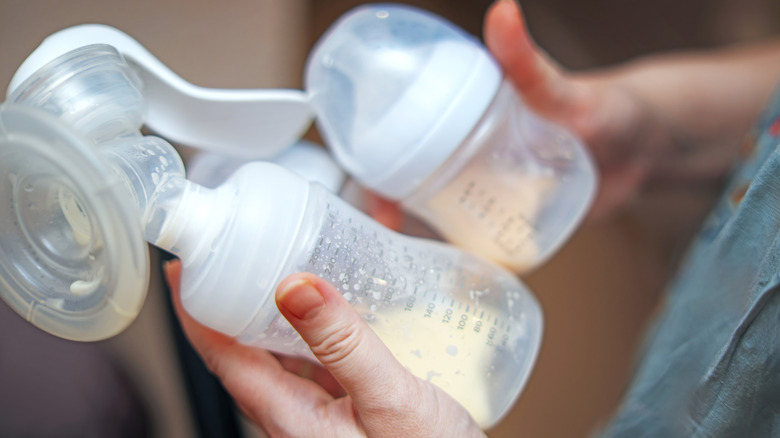
In contrast, manual breast pumps, like the Medela Harmony, are designed with a flange that gets twisted onto the top of a milk collection bottle. Initially, the short side of the handle is pressed until letdown occurs. Next, the user switches to pushing down the handle's longer, opposite side to finish pumping.
For mothers who experience leaking while their baby nurses, the Haakaa is helpful for collecting the released breast milk. However, since it's providing only minimal suction compared to a manual breast pump, medical professionals consider it a more passive way of collecting milk. In contrast, manual pumps are considered more active, since users are continually stimulating the breast to ensure it's thoroughly emptied.
The Haakaa is more of a short-term tool
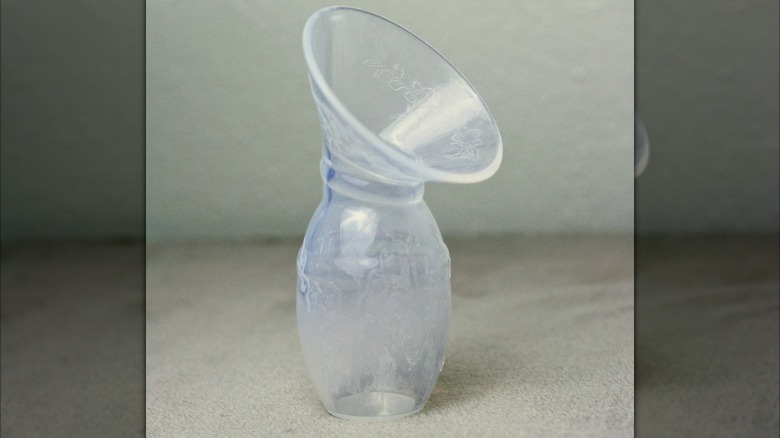
Some moms find the Haakaa helpful at the start of their breastfeeding journey, when leaks are more frequent. Instead of going to waste, this milk can be collected and frozen for later use. "I was able to relieve engorgement so easily and save up tons of milk," one poster declared on reddit. However, during those early days, it's important to know that even a gentle suction can lead the mother's body to produce more than the baby needs, leading to an oversupply of milk. In addition, some moms find it impractical as their babies get older, since mobile tots can accidentally detach the Haakaa while breastfeeding.
Both the Haakaa and manual breast pumps need to be properly cleaned to prevent germs from getting in the milk. In that case, the Haakaa has an edge. The single piece is a lot easier to clean, compared to the mix of small and large components like make up manual pumps.
Even so, for longer-term pumping needs, manual breast pumps may hold the advantage. Breastmilk production is all about supply and demand. Many moms report that manual pumps remove milk more efficiently than a Haakaa, so these devices signal the mom's body to keep making more milk, just like an electric pump. However, since they're used one side at a time, frequent pumpers may find it more expedient to use an electric pump, and pump both breasts simultaneously.