

How To Clean Your Breast Pump Properly To Keep Your Baby Safe
Breast milk contains an impressive blend of nutrients, vitamins, antibodies, and living components to help babies thrive. However, even though breast milk is uniquely suited to defend against germs, if you're pumping, it's important to keep your pump clean to avoid introducing your baby to any harmful bacteria in your home or work environment.
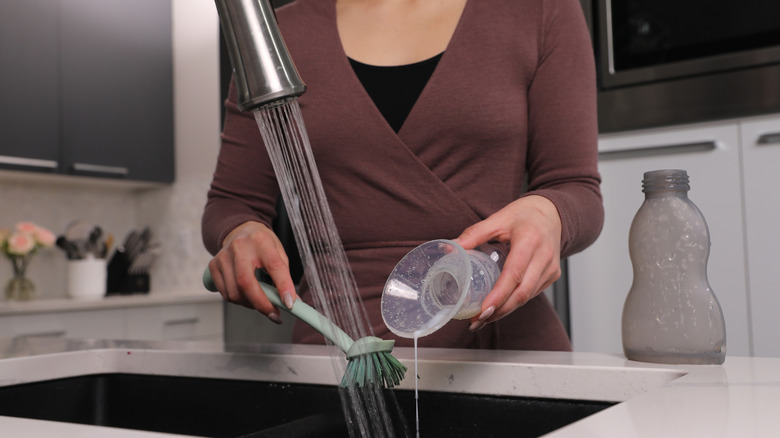
After every pumping session, experts recommend washing any breast pump components that touch milk, including the bottles, valves, and breast shields. Most pump parts can be cleaned by hand with dish soap and water, or in the dishwasher (as long as they're dishwasher safe). Just like with other dishes in your kitchen, giving the parts a quick rinse immediately after using them will make them easier to clean later. If washing by hand, the U.S. Centers for Disease Control and Prevention recommends using a dedicated basin to avoid contact with any germs hanging around in the sink. The same logic applies when using a dedicated cleaning brush.
While washing these parts can be a tedious process, you don't need to hand-dry them. In fact, the FDA advises against using a cloth towel to dry them since it can harbor hidden bacteria. However, the CDC notes that it's okay to use a clean cloth or paper towel as a landing strip while parts air dry. As a third option, a dedicated drying rack might be the easiest way to corral and air-dry all the parts.
Is sanitizing your breast pump necessary?
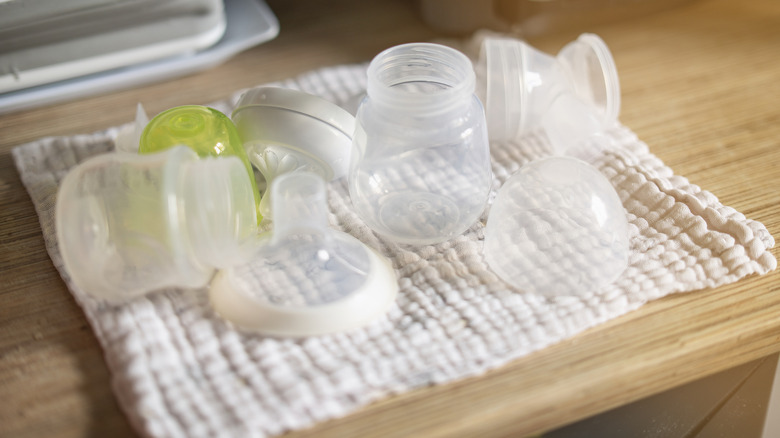
While washing does a thorough job of cleaning in most situations, for babies with special health concerns or infants younger than 8 weeks old, sanitizing pump parts can provide another layer of protection. Washed parts can be boiled daily for five minutes, or, as a more expedient method, some brands sell special disinfectant bags for use in a microwave. In that case, add water and parts to the bag and follow the directions for the correct timing. Another labor-saving option is to clean the parts in the dishwasher and use a sanitizing cycle, although this setting may add significantly more time to the appliance's total runtime. A mesh bag or any lidded baskets inside the dishwasher (like for silverware) can help keep pieces contained during the wash cycle.
Fortunately, other pump parts are pretty low maintenance, such as the motor and connecting tubes. The motor simply needs a gentle wiping, and the tubes typically never need washing since they don't come in contact with breast milk. If milk gets inside the tubes, it's a good idea to toss and replace them, since they can be challenging to thoroughly clean and may indicate the backflow protector is wearing out. Worn parts can lead to lower suction and less milk, as well as hygiene concerns, so it's a good idea to check your machine if you spot moisture in the tubes. If you pump at work or overnight, it might be worth also investing in multiple sets of shields and other parts, which can be a game-changer for busy schedules.