

Is Crawling Considered A Developmental Milestone?
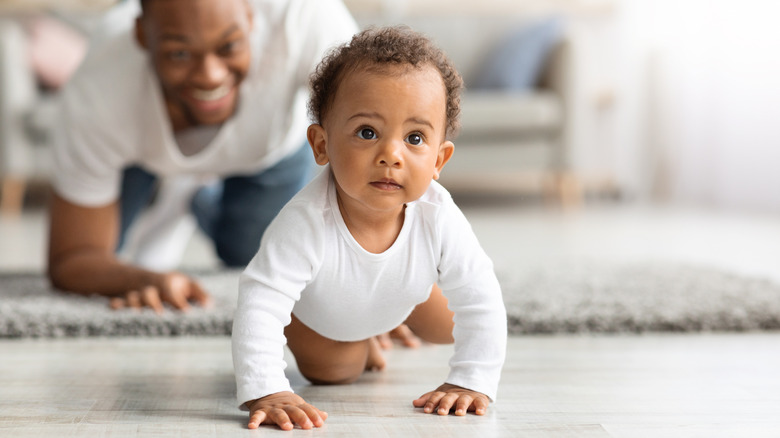
If you're old enough to remember when Pluto got demoted to a dwarf planet, you may have noticed that crawling has gone through a similar downgrade in recent years. It used to be considered a notable developmental milestone at 9 months, but is no longer considered an expected marker of typical development.
In 2022, the Centers for Disease Control and Prevention (CDC) and the American Academy of Pediatrics (AAP) updated their joint developmental milestone checklist in the program, "Learn the Signs. Act Early." This program helps parents and caregivers better understand developmental milestones in their 2-month-old to 5-year-old children. One of the biggest overhauls of the program's metrics was moving milestone measurements from the 50th percentile up to the 75th percentile, meaning that 75% of children at that age have met each milestone.
With the new standards, crawling didn't make the cut. The decision to remove it from the 9-month-old checklist came down to crawling's inconsistency in practice. Babies crawl in all sorts of ways, so it's difficult to define in terms of specific physical movements. Some babies skip crawling altogether, and some cultures even discourage babies from crawling. Still, not everyone agrees that crawling isn't developmentally important, and many pediatric care specialists note that crawling encourages many key developmental skills, including bilateral coordination, body awareness, and even shoulder stability. So you can think of crawling more like a baby (finally) sleeping through the night — it comes with plenty of positives, but it's not considered a set milestone in your baby's development.
Watch for these other developmental milestones as your baby gets ready to walk

Aside from crawling, there are other developmental milestones babies master as they prepare to walk. According to the CDC, by 6 months, babies should be able to push up with straight arms when they're on their bellies, so it might look like they are about to take off crawling at any moment. At 9 months, doctors now focus more on whether babies sit without support and get into the sitting position independently, rather than whether they are crawling. By their first birthday, most babies can pull themselves up to stand and can walk around holding onto furniture. Walking unassisted — without holding on to anyone or anything — is a milestone most babies reach by 18 months.
The "Learn the Signs. Act Early." milestone checklist also lists cognitive, communicative, social, and emotional milestones babies and young children should reach as they grow, which are just as important to look out for as physical milestones. At 9 months, clinicians will be more interested in whether your baby looks at you when you call their name, demonstrates facial expressions, experiments with various babbling sounds, and looks for objects when they suddenly go out of sight (like a dropped spoon) than whether or not they are crawling. While it may no longer be something your child's pediatrician asks about, you can always mention your concerns about crawling or any other developmental skill, regardless of what's on their checklist.