

You'd Barely Recognize What Car Seats Looked Like In The '60s
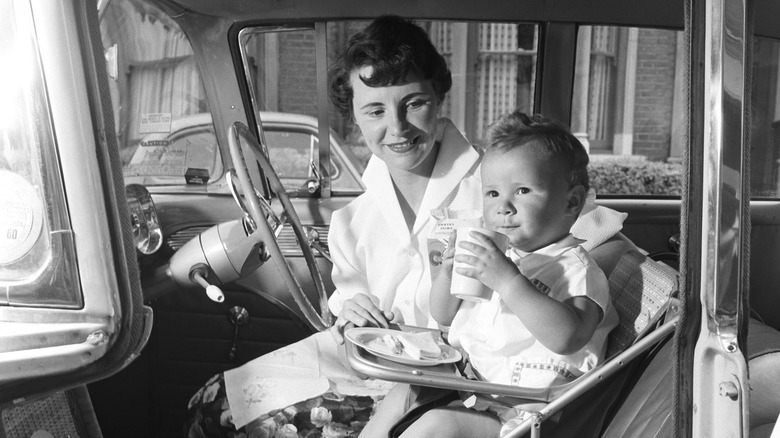
Although Wisconsin passed a front seat belt law in 1961, it took another five years for Congress to create a nationwide directive, mandating front and rear seat belts in vehicles by 1968. Since many families in the 1960s didn't have cars with seatbelts, it's not surprising that children's car seats didn't have rigorous requirements. One predominant car seat of the era was a metal frame that hooked over the vehicle's seat back. This style had been around for decades, and while some of them had a waist belt to help keep the child in the seat, the hooked back wasn't exactly a secure way to anchor the seat within the vehicle. In addition, there weren't any federal restrictions on where to place it, so some tiny tots were riding up front.
Fortunately, some car seats were more similar to their modern counterparts. In 1965, the Jeenay car seat featured a five-point harness. Marketed for the back seat, it was used specifically with the car's lap belt. While 21st century parents have to consider the pros and cons of when to switch to a convertible car seat, 1960s families had a lot fewer options for babies who couldn't sit independently. Fortunately, innovators like Bertil Aldman were experimenting with rear-facing car seat designs. While the result wasn't as robust as a modern car seat, by the end of the decade, GM also released a dedicated infant seat with a rear-facing design.
1960s car seat lore in a fascinating blend of fact and fiction
One persistent internet rumor seems to indicate that a Chevrolet Corvair had a built-in spot to place a reclining baby on a shelf behind the back seat. There's even a period newspaper clipping that seems to make this claim. However, the idea was apparently tongue-in-cheek, and Snopes has firmly debunked the claim. Even so, it's hard to breathe a sigh of relief for '60s vehicle safety. After all, car beds, which looked like a tiny bassinette with a metal frame, were used during the 1960s.
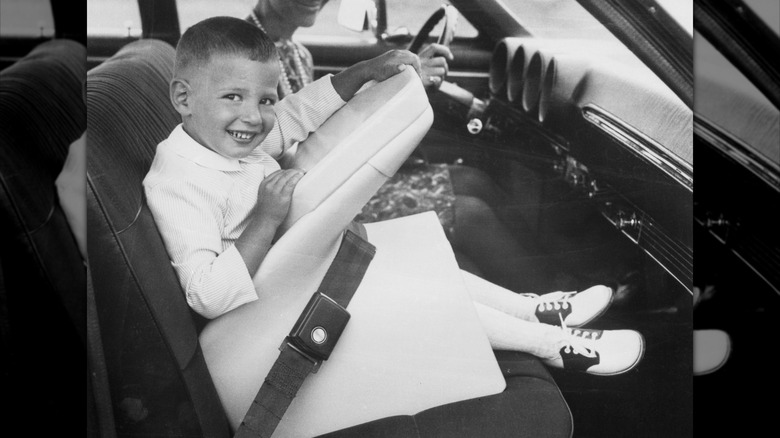
Outside of rumors, sometimes actual car seat designs looked stranger than fiction, like the late '60s Tot-Guard (pictured above). Created by Ford Motor Company, a plastic shell extended over the top of the child's torso and was secured with the car's seatbelt. Inside the Tot-guard was a little seat, but no straps to hold the child in place. Although there was a padded portion in front of the kid's face to protect them in the event of a rear-end collision, it's not clear how easy it would have been for a child to try to slide down and out of the tunnel-like design.
Ford also offered an Astro-Guard seat that was a more conventional-looking, forward-facing seat, although it's unclear if the harness had a strap to prevent the child from sliding down. In contrast, competitor General Motors had a three-point design, with the straps stretching down over the child's shoulders and between their legs to keep them in place. Unlike Ford's Astro-Guard, GM's car seat shell also wrapped around the back and sides of the child's head, just like modern car seats.