

When Should I Switch My Baby To A Convertible Car Seat?

Safety is always a huge consideration with baby gear, especially when it comes to car seats. With newborns, parents typically choose between a dedicated infant seat or a convertible car seat. Convertible seats get their name for their ability to switch between rear and forward-facing installations. When in the rear-facing configuration, convertible seats can be used for newborns.
Some parents prefer to start with an infant seat, since its separate seat and base make traveling easier. For instance, you can get your baby strapped in and settled inside the house, go out to the car, and quickly plug the seat into an already-attached base. However, these seats are a short-term option. They have wide-ranging weight and height maximums, which can impact the length of time your child can safely use them, and they are for rear racing only. For example, some infant seats have a weight limit of 22 pounds, which means kids might be too big for them even before their first birthday. In addition, kids' heads need to be at least an inch below the top of the seat. If not, they need to move on to a convertible seat.
While many infant seats weigh around 10 pounds, convertible car seats can weigh double or even triple that amount. Although that weight makes them more challenging to move between vehicles, this robust design is great for protecting your child, especially their heads. Based on 2022 crash tests, Consumer Reports recommends ditching infant seats by age 1, even if a child still meets the seat's specs.
Rear-facing positions have significant safety benefits
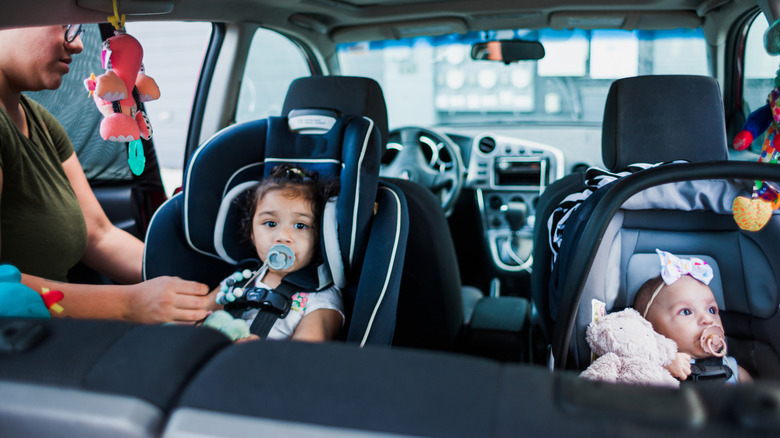
If you've made the switch or are thinking about swapping out your infant seat for a convertible car seat, you may be tempted to face it forward so you can see your little one's face in your rearview mirror. However, safety experts agree that would be a mistake.
In about half of the United States, state law requires kids to rear-face until age 2. The U.S. National Highway Traffic Safety Administration goes even further: "Keep your child rear-facing as long as possible. It's the best way to keep him or her safe." Whether you put your child in a convertible seat at day one or year one, experts agree that sticking with rear-facing positions until your kid exceeds the seat's weight and height guidelines is best. In the event of an accident, rear-facing reduces the chances of head and neck injuries. In addition to the seat's padding and shock absorption, the child's head won't be thrown forward as the vehicle abruptly stops.
Fortunately, many convertible car seat models have more generous weight limits. For instance, if a seat has a 40-pound maximum for rear-facing, an average 4-year-old could meet the weight specs. Other models may fit children up to 50 pounds. Some of these seats are designed with added legroom to make rear-facing more appealing for kids and parents alike. Just like with infant seats, headroom is an important consideration, and the 1-inch rule continues to apply.
After your child has outgrown the seat's rear-facing specs, turn the seat into front-facing mode. While kids will eventually graduate to booster seats, there's no reason to rush the process. As long as the child meets the convertible seat's height and weight requirements, a five-point safety harness will help keep them securely in place.