

What Does 'C' Mean On A Pregnancy Test?

After tracking your ovulation naturally and missing your period, you may want to take an at-home pregnancy test. But you might be surprised at how confusing the experience can be. The instructions don't make sense. The package includes extra items you weren't expecting. (A dropper? A cup?) And, worst of all, you have no idea how to interpret the "C" and "T" areas in the test strip window.
You're not alone in your frustration. Studies have shown that many women have trouble reading their at-home pregnancy tests, including the types that feature double lines. However, you can get up to speed by first understanding what those lines mean, starting with the one that's labeled with the letter "C", which is shorthand for the word "Control."
When you introduce your urine onto a pregnancy test strip via a dropper, by dipping it into urine, or by urinating on it, the strip begins to absorb the urine. The liquid then comes in contact with antibodies that are looking for evidence of the hormone called human chorionic gonadotropin (hCG). There's a simple reason why: Soon after you become pregnant, your hCG levels begin to build. In fact, during early pregnancy, your hCG levels will double every couple of days. However, the "C" doesn't detect hCG; that's the job of the "T" line. Instead, a visible "C" line lets you know the test absorbed enough urine and everything is functioning properly.
What does a faint line on a pregnancy test mean?
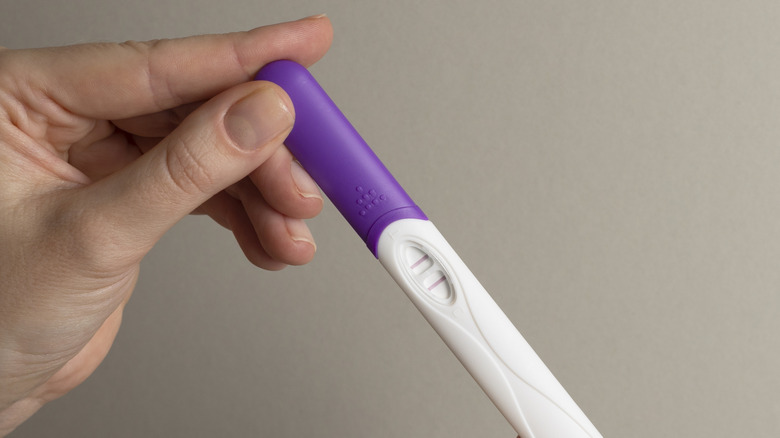
By the time your urine reaches the "C" line, it has passed through the test's reagents and activated the control mechanism. If all is well, the "C" line will appear pretty sharply, and you can expect answers shortly. The "C" line will show up before the "T" line (the line that shows if hCG is present and if you need to start looking into popular, whimsical baby names). The "T" line may or may not appear within a few minutes, though that time may vary by manufacturer.
You may discover that your "C" line looks crisp, but your "T" line is barely visible. As long as the "T" line is the right color (usually pink or blue on many at-home tests), you can take it as a sign that the test picked up hCG and you're most likely expecting. On the other hand, if you don't see a "T" line and the "C" line is present, your reading is likely negative.
What happens if the "C" line doesn't show? Whether the "T" line becomes visible or not, if there is no "C" line or it's faint, you have an invalid test and need to take another one. While at-home pregnancy tests may be marketed as 99% accurate, that doesn't mean they always give clear answers, particularly if they're expired. It's also important to follow all those confusing directions, which can vary by manufacturer. Otherwise, you could experience user error and have to retake the test.