

10 Baby Names Inspired By Stars And Constellations

Maybe you're a big fan of Space Age history, or you're excited about what future space exploration has in store. Perhaps you simply find the celestial sky to be a fascinating source of wonder. Whatever the reason, looking to the stars for potential baby namesake choices is a stellar move — not least because you have so many worth considering. One great approach is to take a look at your baby's potential zodiac sign, which is named for its respective constellation, or you could even look at the sign of an important figure in your and your baby's lives.
Another option is to look at specific star names. These are carefully selected by the International Astronomical Union and often steeped in history and lore. In fact, that's why so many stars and constellations are often paired with iconic myths and inspiring legends that have long fascinated us earthlings. With this in mind, we've rounded a few potential picks for naming your tiny star.
Selene

In Greek mythology, Selene is a stunning Titan goddess and the personification of the moon, known for her crescent-shaped crown and sky-crossing chariot pulled by horses. As such, Selene simply means "the moon," and it's a name on the rise. While Selene had a spotty appearance on the list of top 1,000 baby names in the '90s, per the Social Security Administration (SSA), she re-emerged in 2017 and has slowly climbed the ranks over the last few years. As of 2025, Selene was the 623rd most popular girl's name in the U.S.
Lyra

Named for the lyre, a stringed instrument, and linked to the musician and poet Orpheus of Greek mythology, Lyra is both a beautiful name and a stunning constellation. It's also heavily associated with summer in the northern hemisphere, as that's the best time of year to view this particular array of stars in that region. Along with "lyre," the name also means "harp."
Orion

While most amateur stargazers can easily identify the three bright stars of Orion's belt, it takes a well-trained eye to piece together the larger constellation of Orion. The fierce hunter is linked to the goddess Artemis. In some versions of the myth, upon his death, Artemis asked her father, Zeus, to place Orion in the sky where she could always see him. This is why, as a name, Orion means "light of the heavens."
Andromeda
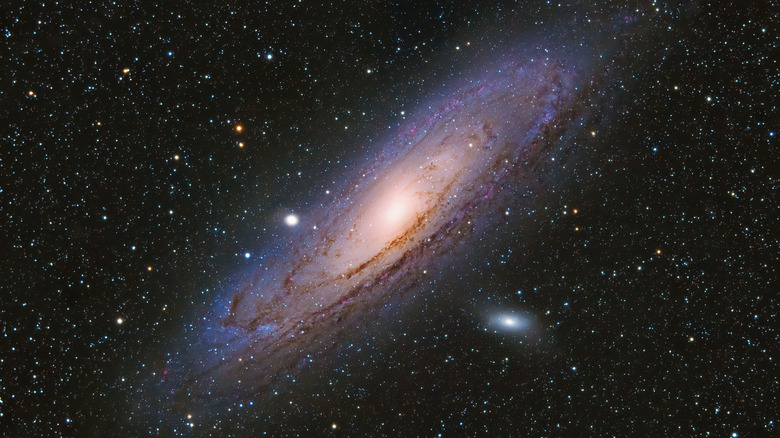
For a name that's truly far-out, consider Andromeda — the galaxy closest to ours that's also bright enough to be spotted without a telescope. Its name traces back to ancient Greece, where in mythology, Andromeda was a mortal princess whose beauty angered the gods. The name is said to mean "ruler of men," and you'll have no shortage of cute nicknames. Potential options include Andi, Ana, Meda, and Romy.
Vega

Located within the constellation Lyra, Vega is one of the brightest stars in our sky and, in the summer of 1850, became the first star to be photographed. The star's name is rooted in Arabian astrology and dates back to the 6th century AD. Today, Vega is most commonly understood to mean "swooping eagle." But separately, Vega also has Spanish origins, where it means "meadow" as well as "fertile plain."
Altair
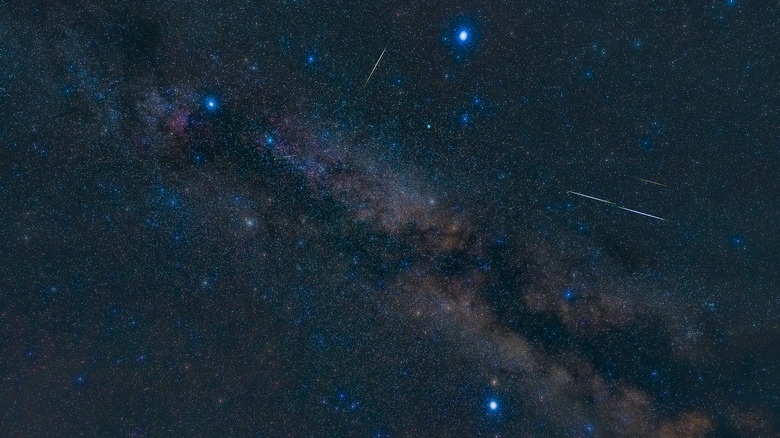
For another potential name that's associated with an exceptionally bright star in our sky, you might consider Altair. This star is the standout sparkler in the Aquila constellation, which is itself also known as the Eagle. Along with Vega, Altair is a prominent feature in the summer triangle, which is a small pattern of three bright stars seen in the summer months in the northern hemisphere. This makes Vega and Altair a great option for celestial sibling or twin names. Like Vega, the name Altair also has Arabic origins and means both "flyer" and "flying eagle."
Rigel

If you've ever looked up at the sky and spotted Orion's belt and immediately noticed an exceptionally bright star just off to the side, that's Rigel. Considered a blue supergiant star that's on track to becoming a supernova, you'd be hard-pressed to pick a more grandiose namesake from our skies. But the actual meaning of the name is far more grounded. With Arabic roots, Rigel means "foot" and stems from a longer phrase that roughly translates to "the left foot of the central one."
Cassiopeia

Recognized for having a distinct M or W shape, the constellation of Cassiopeia is named for a beautiful queen and the mother of Andromeda. The meaning of the name seems to vary, with some claiming it means "she who entangles men," while others note it as a nod to "cassia juice," which comes from the cassia plant and may have healing or medicinal properties.
Polaris

More commonly referred to as the North Star, Polaris is a beautifully bright spot in the sky known for being a helpful navigation point if ever you're lost. The name Polaris has Latin origins that literally mean "pole star." It's also a part of the Ursa Minor constellation, which is Latin for "little bear" and is also known as the Little Dipper.
Antares

If you'd like your baby to have a name connected to the star sign of Scorpio, consider Antares, the constellation's brightest star. The name has Greek origins and is said to mean both "brightest red star" and "rival of Mars" or "rival of Ares." In Roman and Greek mythology, Mars and Ares are the respective gods of war, arguably giving Antares more peaceful connotations.