

What Babies Can See, From Birth To One Year
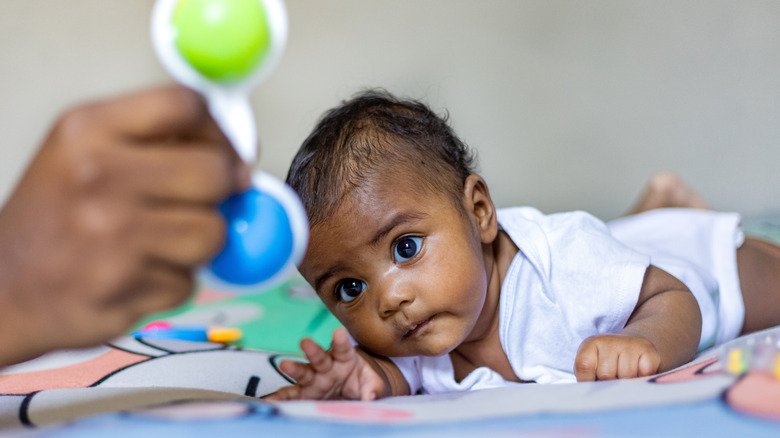
Babies go from spending nine months in a cozy and mostly dark womb to being born in all the colors and lights of this world. It's got to be disorienting! Luckily, infants' eyes aren't quite as developed as ours are, giving them a bit of a buffer before taking in everything around them. In fact, when they are first born, up until about 1 month of age, babies can only make out objects within a foot – the perfect distance to see their mom's face.
Newborns are also sensitive to light and don't have great control of their eye movements. They aren't admiring all of life's colors, either. Although infants can detect some color, highly contrasting hues such as black and white or bright red are much more noticeable. By 1 month, a baby should be able to notice large shapes and brightly colored objects up to a yard away. By 6 weeks, they should be making eye contact with their parents, which is the cutest thing ever.
In their first few months, babies' eyes go through a lot of changes. By 3 months old, your little one should be able to track an object with their eyes working together to focus. They may even be able to reach their hand out to try to touch a toy that they see! One of the sweetest developments is that a baby may be able to recognize faces now.
Depth perception, colors, and hand-eye coordination develops
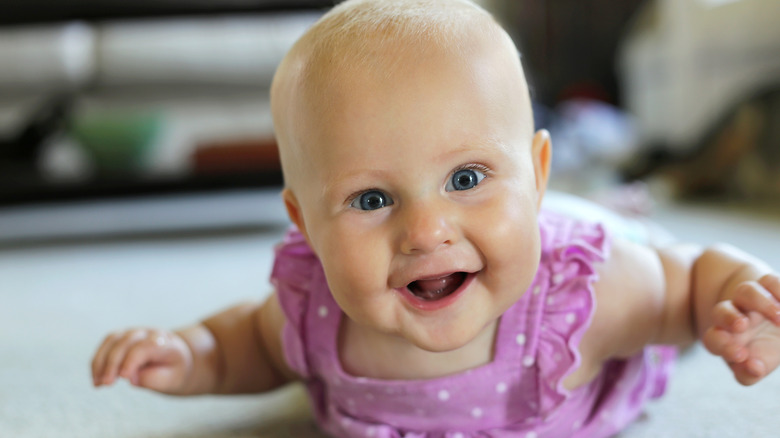
From 4 to 6 months of age, babies will start to see farther away and can recognize their mom, even when she's not right beside them. They will also develop enough depth perception to see the world in multiple dimensions around this age, as well as enjoy the many colors of the world. How's that for some rapid development?
As babies become more mobile, their vision adapts to help them master crawling. By 9 months old, babies can see and judge distances as their hand-eye coordination develops alongside crawling and as they learn to pull themselves up to standing. By the way, crawling helps babies improve their hand-eye coordination, which is one reason this is such an important milestone. Babies at 10 months old can often grasp something small using their fingers, and when they reach their first birthday, babies should be able to take aim and throw things— so watch out!
On the other hand, it's also important to know what to look for that could indicate a health issue or vision development delay. Parents should look for any of the following potential early warning signs of eye or vision problems:
- Inward or outward turning eyes
- Trouble tracking objects
- Discomfort with bright lights
- Red or encrusted eyelids or a lot of tearing
- Unequal pupil size
- The need to move their head to see objects more clearly
- Frequently close one eye
- Eyes that don't line up
- A white or grayish-white pupil
- Rapid, involuntary eye movements
- Drooping eyelids
All babies develop at their own pace, but if your little one isn't reaching the above vision milestones or is experiencing one of these warning signs, then it's important to reach out to your child's healthcare provider for an evaluation.