
Everyone Had It In The '60s — Now It's A Great Screen-Free Activity For Kids
We may receive a commission on purchases made from links.
When my family and I started renovating a teeny tiny cottage in the English countryside, we made the slightly controversial decision not to wire it for a television. Because of this, we're constantly on the hunt for analog activities we can introduce to our two kids, and we were delighted to recently learn that the beloved Spirograph is still around. At first, I figured it would be a fun alternative to their standard pile of coloring books and art supplies. But then, the more I looked into it, the more I realized there are other benefits to letting your kids explore their creative sides through a Spirograph.
If you've never seen a Spirograph before, it's a toy drawing set that uses gear-shaped plastic pieces that fit together to help guide your pen or pencil around in circles until you create your own geometric art. A typical set today comes with see-through gear pieces, along with drawing pens and a handy case to hold all the parts.
While mathematician Bruno Abdank-Abakanowicz created the concept of the spirograph in the late 19th century, it was British engineer Denys Fisher who developed the toy as we know it today and introduced it to the world at a German toy fair in 1965. From there, the Spirograph was licensed and launched in the United States the following year, and by 1967, the drawing tool had taken the world by storm. That year alone, it won three international awards, including Educational Toy of the Year in the United Kingdom. Some historical accounts also show that more than 5 million Spirographs were bought in the latter part of the '60s, with millions more sold around the world the following decade.
The surprising benefits of playing with a Spirograph
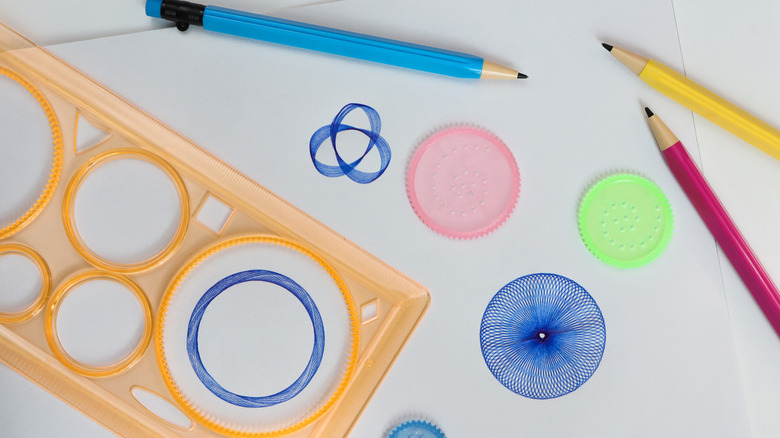
Even as a kid, I remember the drawings that came from my spirograph felt impossibly intricate and complex, and the process to create these circles can border on hypnotic. I wasn't surprised to learn that today, it's often used to help children and adults relax. But what did surprise me was the revelation that the drawings are also incredibly mathematical. In fact, the shapes created by a spirograph are an excellent way to introduce children of all ages to mathematical patterns and geometry by exploring symmetry and movement.
Unlike when we were kids, there are now a variety of Spirograph models available, depending on ages and abilities. The original set and more complex models are best for ages 8 and older, while the Spirograph Jr. sets rely on bigger gears and marker pens for easier gliding. Choosing the right version based on your child's abilities is important so they can focus on exploring their creativity and feeling empowered rather than frustrated as they make their spiral art. You can also look for travel sets, giant-sized versions, and modern options that include a Die-Cast Collectors Set. There's even an animator model if you have a tiny tech-lover, or versions that play with neon colors or shimmering scratch paper if your artist prefers exploring their abilities through color and texture.