

The Average American Woman Had This Many Kids In The '60s (And How It Compares To Today)
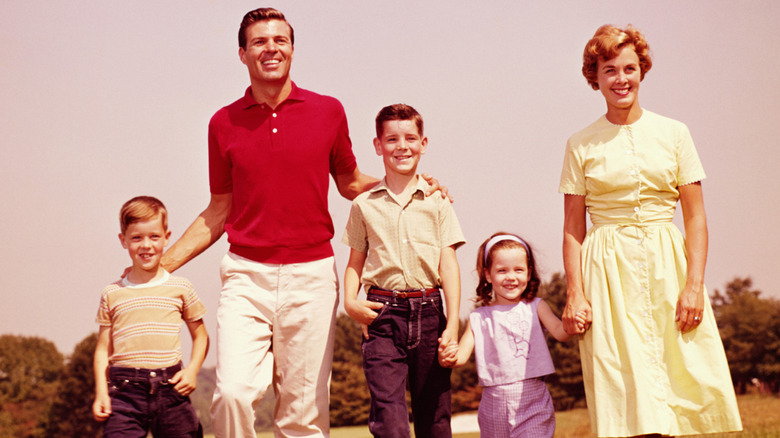
The 1960s were split across two generations: the end of the Baby Boomers and the beginning of Generation X, and changing family sizes reflected this shift. Back in 1960, Federal Reserve Bank of St. Louis records show the fertility rate in the United States was about 3.65. In other words, the average American mom had about three kids, and some had four to get that fraction of a decimal. By 1969, the fertility rate was about 2.46, showing that two-child families were becoming more common, with the occasional third kid here and there.
Fast forward to modern times, and by 2024, that number had dropped to an average birth rate of just 1.63. Of course, life 60 years ago was vastly different, and there are several reasons why people may have had more kids. For starters, fewer moms were trying to balance working and childcare responsibilities. The U.S. Bureau of Labor Statistics shows women made up around 40% of the labor force in the 1960s. In contrast, today, about 74% of moms are working and parenting.
Families in the '60s may have spent less on housing and transit for their kids, too. U.S. laws didn't require cars to have seatbelts until 1966, so families didn't necessarily have to purchase a larger vehicle to accommodate more backseat passengers or purchase multiple rounds of child safety seats and boosters. Although home sizes haven't changed all that much (1,500 square feet in the 1960s vs. almost 1,800 square feet today), three-child families in the past were most likely sharing bedrooms. According to the U.S. Census Bureau, fewer than 17% of homes in the 1960s had four or more bedrooms.
Expanding a family is a complex choice in any era

Although we often think of everything being cheaper in the past, surprisingly, parents in the 1960s were spending more on children since they had larger families. In 1960, it cost a little over $25,000 to raise a kid, or $285,000 in today's money. Today, those costs are about $303,400 per kid. Multiply that $285,000 by three, and typical families in the 1960s were spending substantially more than a one-child family in the 2020s. With today's costs of living overall, it's not surprising people might not feel able to spend over $900,000 raising three kids.
Costs aside, over the last 120 years, the mid-20th century was a bit of an outlier. In the early 1900s, the fertility rate was 3.56, which was a smidge lower than the 1960s. Just like today's fertility rates, these numbers reflect a complex combination of personal desires, finances, and healthcare factors. While some contend the baby boom was a direct response to life after the Great Depression and World War II, others assert the trend was more connected to medical advances that made birth safer, as well as ample, affordable housing. Birth was also substantially cheaper in the 1940s, so families didn't have to face a big bill along with bringing home their new baby.
These days, even though medical technologies keep advancing, services like fertility treatments can be exorbitant, and hospitals with maternity wards may be far away, making it hard to access care. In addition, like the worldwide events leading up to the baby boom, the COVID-19 pandemic may have had repercussions in the opposite direction, causing some people to have fewer children.