

The Laundry Detergent You Use Matters To Your Baby — Here's How To Choose
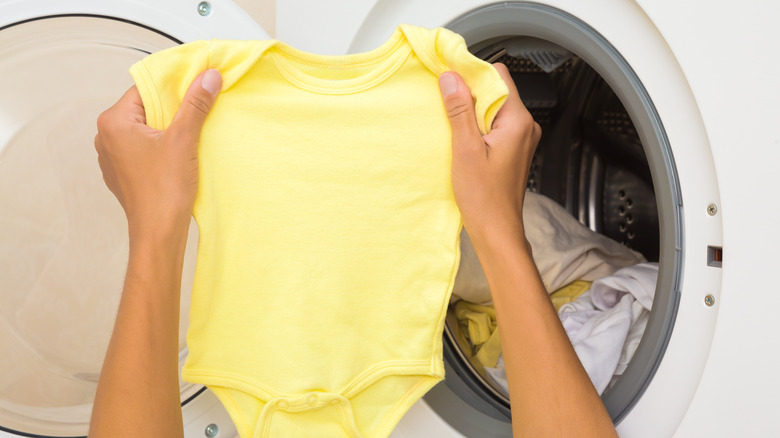
Between clothes, crib sheets, and cloth diapers, babies can create a lot of laundry. When you're shopping for detergent, you've probably noticed some brands and formulas marketed especially for babies. We often think of a baby's skin as more delicate, but one scientific study proves it — showing that the skin of an infant is at least 20% thinner than an adult's. Babies are also more prone to topical allergy concerns, and conditions like eczema can be exacerbated by chemicals in products like laundry detergent. However, when selecting a detergent that won't irritate your baby's skin, these baby-specific formulas aren't necessarily the best choice. The Environmental Working Group (EWG) graded widely available baby detergents, and several of them scored poorly due to concerning ingredients like synthetic chemicals.
When choosing a baby-friendly laundry detergent, seek out products that are unscented and dye-free. Plant-based detergents can also be better for sensitive skin, since many are petroleum-free. You can also check items with EWG's database or the U.S. Environmental Protection Agency's Safer Choice Program to find items that excel in meeting safety criteria. Besides benefitting your baby, these safer formulas are a gentle, effective choice for the whole family, and you can save time by commingling clothing (diapers are more effectively washed in a dedicated load). In addition, washing everyone's clothes before the first wear also goes a long way toward reducing skin irritation from the manufacturing process.
Fortunately, skin-friendly formulas can also be tough on stains. However, among diaper leaks, spit-up, or food stains, babies can push these capabilities to their limits. If you need a stain remover, like with laundry detergent, fragrance-free is the best choice.
Make laundry safety a top priority
Beyond choosing a skin-friendly laundry detergent, there are also multiple options, including liquids, pods with powder or liquid inside, fiber-based tiles, or dissolvable laundry sheets. These are all effective in terms of cleaning clothes, and the premeasured formulas can make it faster to pop a load of clothes in the washer. Although products like pods have gotten more media attention in terms of their dangers (especially choking hazards), all types of laundry detergent pose safety concerns and should be inaccessible to kids. Multiple lines of defense are best to deter curious explorers. In addition to making sure the detergent container is tightly sealed, place it on a high shelf, preferably one with a door that can be secured.
Fortunately, once you've chosen a detergent and stored it in a secure location, you don't need anything else, especially fabric softeners. Although fragrance and dye-free fabric softeners and dryer sheets are available, safety, rather than skin sensitivity, is the main concern. Build-up from these products can interfere with clothes that have flame-resistant properties, like pajamas.
To avoid mix-ups, you may want to start a no-fabric softener policy on all laundry. This strategy has widespread benefits, since softeners can gunk up your other clothes as well as your washer. As an alternative, wool dryer balls can be used on the whole family's laundry. Since these balls can accelerate the drying process, you could save considerable time and energy on laundry by the time your newborn becomes a toddler.