

When To Trim Your Newborn's Nails
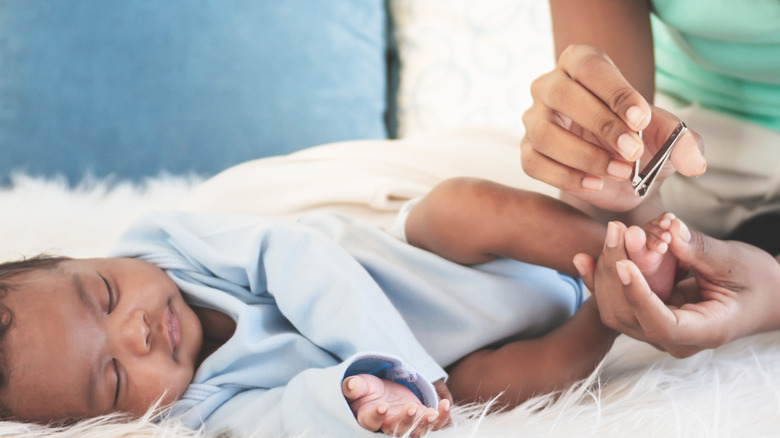
When you're marveling at your newborn's tiny fingers and toes, you may notice that their nails are longer than expected. Since fingernails and toenails are already providing full coverage by 34 and 38 weeks in the womb, respectively, that gives some serious opportunities for growth before birth. These nails can be sharp, putting your baby at risk of scratching themselves. While you can use special infant clippers after your baby is born, some medical professionals advise filing the nails during the first two to four weeks instead. After this time period, and as their nails take longer to grow, you can resume using clippers. Baby gloves and socks can also buy some time and protect newborns' hands and feet from accidental scratching.
Since newborn nails are a lot more bendable, a glass file can be more effective than emery boards or metal files intended for harder adult nails. Many parents find it helpful to file when the baby's sleeping, so they can focus on the task without wiggling or fussing. For instance, if your baby has just gone to sleep after feeding, one parent could care for the nails while the other holds the resting child.
Although filing can take a while, it's easy to start and stop if your baby wakes or needs a clean diaper midway through the process. Filing also allows you to continuously check to ensure the nails aren't getting too short, reducing the margin for error that comes with clipping. Typically, your baby's fingernails need maintenance at least weekly, so you'll quickly become a skilled nail tech. Toenails grow at about half that pace, so you could do an alternating schedule of fingers only, followed up by fingers and toes, to keep your baby's nails in shape.
Nailcare tips for growing babies
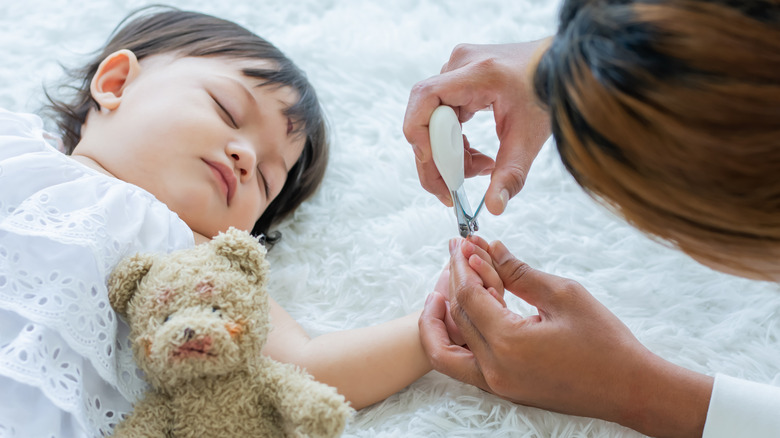
As your baby grows, you might want a more expedient nail-trimming option. Choose baby-specific nail clippers or scissors, which are a lot smaller and safer to use. Once again, a sleeping child makes the process a lot less stressful. Some clippers even have features like LED lights and magnifying lenses to make it easier to see small nails, even if the room is dimmed for resting. For kids who wake more easily, parents can also distract them by singing, playing with, or feeding the baby while trimming. Some clipper brands even add cute animal elements and sounds to make the process more entertaining.
In addition, it's often helpful to wait until the nail is long enough to avoid getting too close to the surrounding skin as you maneuver the scissors or clippers. A baby nail file can be useful alongside scissors and trimmers, to smooth a freshly cut edge, or for in-between times when a nail needs a little TLC but isn't quite long enough. However, accidents can happen to even the most confident cutters. In that case, apply pressure to stop the bleeding and wash the cut. Skip bandages, since infants have a penchant for putting their hands and feet in their mouths.
Although clipping is a lot quicker than filing, it's also a little messier. Nail bits can sometimes go flying in unexpected directions, so be careful not to lean in too close and accidentally get one of those pieces in your eye — yes, that can happen. While you can angle your body to shield your baby from wayward clippings, you might want to don some eye protection, like safety goggles or glasses.