

Baby Vs Adult Sunscreen: What's The Difference?
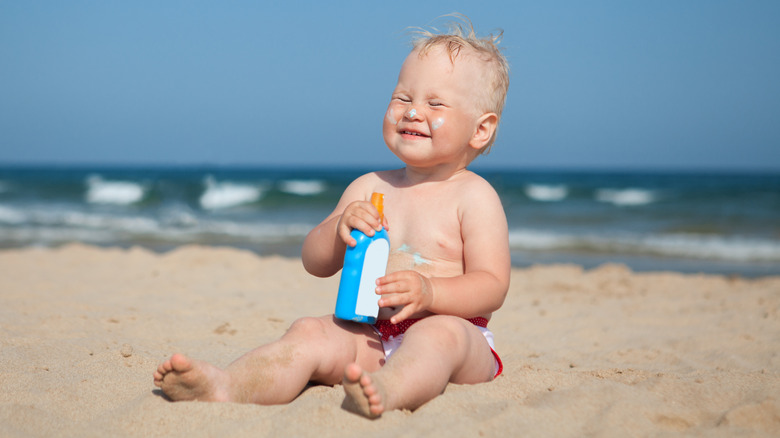
For people of all ages, sun protection is paramount. For kids younger than 6 months old, shade and sun-shielding clothing are the name of the game, since infants are below the recommended age for wearing sunscreen. After that, parents have a new challenge — which sunscreen to choose. While some sunscreens are marketed to adults, others are more appropriate for kids, especially younger children.
"Many baby sunscreens are specially formulated to be used on sensitive skin," said Dr. Debra Jaliman, a board-certified dermatologist and assistant clinical professor of dermatology at the Icahn School of Medicine at Mount Sinai. "They are usually fragrance-free and use less ingredients. Many of them are physical sunscreens, meaning that they physically block the UV rays." Similar to wearing clothing that blocks the sun, these sunscreens are less invasive since they rely on minerals to create a protective barrier. "These ingredients include zinc oxide and titanium dioxide," Jaliman added. "The American Academy of Dermatology specifically recommends physical sunscreens for babies and young children."
In contrast, chemical sunscreens are more like a paper towel, soaking up UV rays. While they are effective, they are designed for adult use. "These chemicals can be absorbed through the thin skin of babies and children," Dr. Jaliman noted. "They are also more irritating on delicate sensitive skin." When considering a prospective sunscreen for your child, she advises skipping anything containing chemicals like avobenzone, oxybenzone, octocrylene, homosalate, octisalate, and octinoxate. To make your decision process even easier, the Environmental Working Group offers a database where you can look up a specific sunscreen to examine the safety of its ingredients. Some baby sunscreens rely on a combo of mineral and chemical sunblock strategies, and the EWG is quick to flag formulas with ingredients to avoid.
Become a sun-protection pro
Fortunately, both adults and kids can wear baby-friendly sunscreens. In fact, some brands use the same ingredients for both their all-ages and baby physical sunscreens. One sunscreen for the whole family can really streamline things, whether you're packing for a vacation or keeping a bottle stowed in your purse or diaper bag.
However, once you pick a mineral sunscreen for your little one, make sure you apply it correctly. "The biggest mistakes that parents make are using too little sunscreen, not reapplying the sunscreen at two hours, and missing certain areas like the ears, back of the neck, and the back of the legs," Dr. Debra Jaliman said. While the general rule of thumb is 2 tablespoons for adults, the recommended amount is closer to 1 tablespoon for babies.
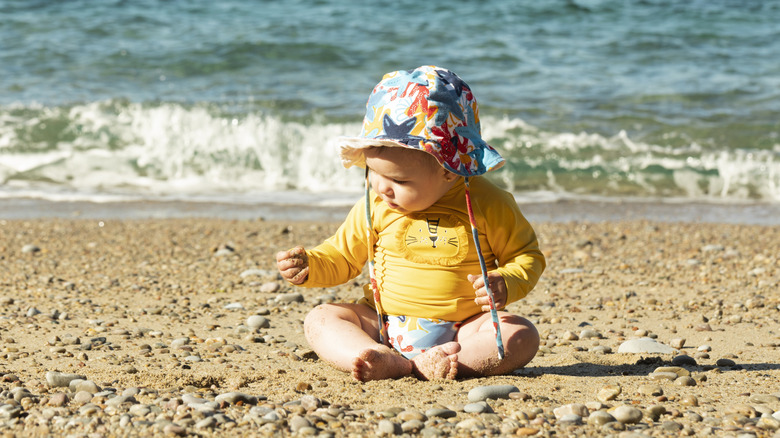
To keep baby's ears and necks even more protected, you may want to supplement your sunscreen routine with a cute UPF 50+ hat. Styles range from wide-brimmed options to caps with a skin-shielding flap that extends down the back and sides. To cut down on your workload even further, there's also sun protective clothing, like rash guards. These are comfy, lightweight, and quick drying, and have built-in UPF 50+ protection. Besides long-sleeve shirts, there are also options with long pants to provide even more coverage. Features like separate pants and a matching shirt or a body suit with a full-length zipper keep diaper changes manageable, too.